
Why How Damaged Panels Affect Your Door’s Performance Is More Serious Than It Looks
How damaged panels affect your doors performance is something most homeowners underestimate — until a small dent turns into a costly repair bill.
Here’s a quick summary of the key ways panel damage impacts your garage door:
- Balance and alignment – A warped or bent panel shifts the door’s weight unevenly, forcing every other component to compensate
- Springs and cables – Uneven load can cut spring lifespan nearly in half — springs rated for 10 years may fail in just 5
- Hinges, rollers, and tracks – A misaligned panel creates friction and binding that wears out hardware prematurely
- Garage door opener – The motor works harder to move an unbalanced door, leading to burnout and auto-reverse failures
- Insulation and energy efficiency – Cracks and gaps destroy the door’s thermal barrier, letting in air, moisture, and pests
- Home security – Structurally weakened panels are easier to breach and can create entry points for intruders
Garage door panels are not just decorative. They are structural components that keep the entire system — springs, cables, tracks, rollers, and opener — working in harmony. When even one panel is damaged, the effects ripple outward across the whole door.
This is especially relevant for homeowners in Northern Virginia, where seasonal weather swings, humidity, and temperature changes put extra stress on garage door materials year-round.
A damaged panel may seem like a minor eyesore today. Left unaddressed, it can become a safety hazard and an expensive system-wide failure tomorrow.
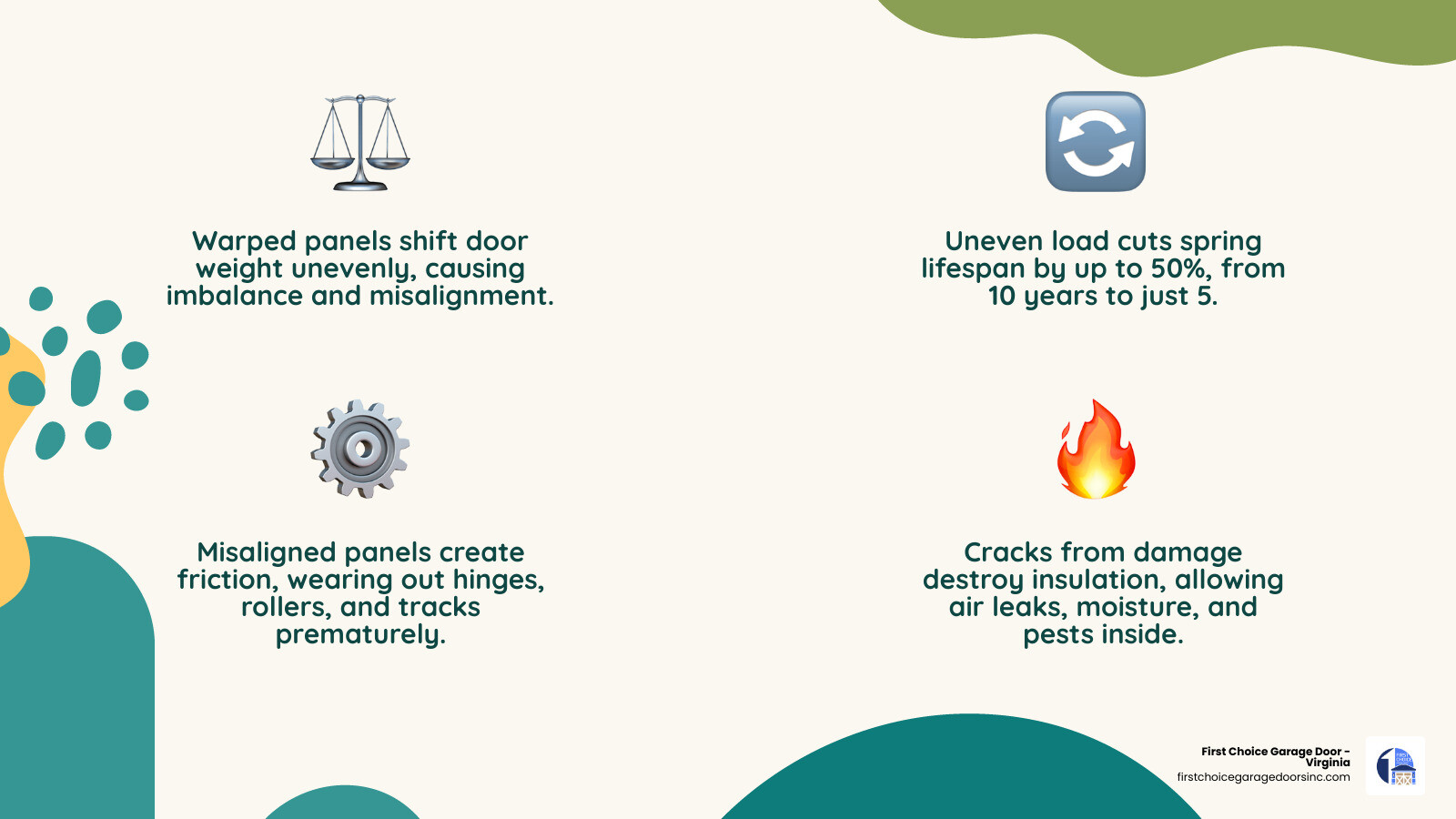
How Damaged Panels Affect Your Doors Performance and Balance
When we talk about how damaged panels affect your doors performance, the conversation always starts with balance. A garage door is essentially a giant scale. Each sectional panel is designed to contribute a specific amount of weight to the overall system. When a panel is crushed by a vehicle impact or warped by the humid Virginia summers, its shape changes, and so does its center of gravity.
This shift in weight distribution is a major problem. Even a slight bend in a steel or wood panel can cause the door to “pull” to one side. This creates structural stress that the door was never designed to handle. If you notice your door sitting crookedly in the frame, you are seeing the first signs you need a garage door repair.
The counterbalance system—which includes your springs and cables—relies on the door being perfectly level. When a panel is damaged, the door becomes “dead weight.” Instead of gliding smoothly, it fights against the tracks, leading to a jerky, unstable motion that can eventually cause the door to seize up entirely.
Mechanical Strain and How Damaged Panels Affect Your Doors Performance
The mechanical components of your door are the first to feel the “ripple effect.” Sectional doors move by folding at the hinges as they navigate the curve of the tracks. If a panel is bent, those hinges can no longer pivot at the correct angle. This leads to hinge binding, where the metal plates grind against each other rather than rotating freely.
Furthermore, a warped panel pushes the rollers into the side of the track with excessive force. This creates roller friction, which wears down the ball bearings and can even cause the rollers to pop out of place. Knowing when your garage door has come off track is vital, as a door that has slipped its tracks is a massive safety risk to your family and vehicles. Over time, this constant hardware fatigue will lead to snapped bolts and bent tracks that require professional intervention to fix.
Opener Fatigue and How Damaged Panels Affect Your Doors Performance
Your garage door opener is designed to lift a balanced door. When a panel is damaged and the door loses its equilibrium, the opener has to pick up the slack. This results in significant opener fatigue. You might hear the motor straining, or notice the door moving much slower than it did in previous years.
This extra work leads to motor burnout and can strip the gear assembly inside the unit. Even more concerning is how panel damage affects safety settings. A warped panel can cause the door to vibrate so much that it trips the sensitivity settings, causing the door to reverse mid-cycle. In some cases, a bent panel might even physically block the auto-reverse sensors or the photo-eye path, preventing the door from closing at all.
The Impact on Springs and Hardware Longevity
If the panels are the body of the door, the springs are the muscles. Unfortunately, the muscles are usually the first thing to tear when the body is out of alignment. Statistics show that springs that should last ten years might fail in half that time—failing in as little as five years—due to the added stress from damaged panels.
When a panel is warped, the spring tension becomes uneven. One side of the torsion bar may be under significantly more torque than the other. This imbalance doesn’t just wear out the springs; it also leads to cable fraying. As the cables struggle to lift an uneven load, the steel strands begin to snap one by one. Understanding the risks that come with having a damaged garage door is essential because a snapped cable or spring can cause the door to come crashing down without warning.
Compromised Insulation and Energy Efficiency
In Northern Virginia, we see everything from freezing winters to sweltering, humid Julys. Your garage door panels act as a thermal barrier, helping to regulate the temperature inside your home—especially if you have a bedroom located above the garage.
When a panel is damaged, it often develops cracks or gaps where the sections meet. This destroys the door’s R-value, which is the measure of its thermal resistance. What is garage door warping and what should you do if it happens? Warping creates air leaks that allow conditioned air to escape and outside air to rush in.
Beyond just higher energy bills, these gaps invite moisture intrusion, which can lead to mold growth on the interior of the panels. Perhaps most annoyingly, these small openings serve as “welcome mats” for pests like rodents or insects looking for a dry place to nest. Maintaining your weather stripping and ensuring your panels are flush is the only way to keep the elements out.
Identifying Critical Signs of Structural Failure
Not all damage is created equal. A small scratch from a bicycle handle is cosmetic; a dent from a car bumper is often structural. Homeowners should regularly perform a visual and audible “health check” on their doors.
One of the most obvious signs of trouble is visible bowing. If the door looks like it is “smiling” or “frowning” when it is halfway open, the structural integrity has been compromised. You should also listen for audible grinding or popping sounds during operation, which indicate that the panels are no longer moving in sync. Why a bowing garage door is a problem and how you can fix it usually involves reinforcing the sections or replacing them entirely.
To help you decide how urgent your situation is, consider what can cause a warped garage door and use the table below to categorize the damage:
| Feature | Cosmetic Damage | Structural Damage |
|---|---|---|
| Visual Appearance | Surface scratches, paint chips, small shallow dents. | Deep creases, cracks through the material, visible bowing. |
| Door Movement | Operates smoothly and quietly. | Jerky motion, stops mid-way, or moves unevenly. |
| Sound | Normal humming or slight rattle. | Loud grinding, popping, or screeching. |
| Alignment | No gaps between sections when closed. | Visible gaps that allow light or air to pass through. |
| Opener Effort | Opener moves the door effortlessly. | Opener sounds strained or motor gets hot. |
Deciding Between Panel Repair and Full Replacement
One of the most common questions we hear in Manassas is: “Do I really need a whole new door?” The answer depends on the extent of the damage and the age of your system.
If your door was manufactured recently and only one panel is dented, a single-section replacement is often the most cost-effective path. However, if your door is over 15 years old, finding a matching panel can be difficult because manufacturers frequently discontinue older styles. In these cases, putting a new panel on an old door is like putting new tires on a car with a blown engine—it doesn’t solve the underlying wear on the springs and tracks.
Knowing when to repair vs replace your garage door involves looking at the 70% rule: if the repair costs approach 70% of the cost of a new door, replacement is almost always the smarter long-term investment. Choosing between garage door repair or replacement is a decision we can help you make after a thorough inspection. And if you’re wondering, “should you use a dented garage door,” the answer is usually “only with caution.” If the dent is deep enough to affect the tracks, using the door could cause it to collapse.
Frequently Asked Questions
Can I operate my door with one dented panel?
Technically, yes, if the dent is minor and cosmetic. However, if the dent has caused the panel to bend or crease, it creates an imbalance. Operating the door in this state puts excessive strain on the opener and can lead to secondary damage to the tracks and rollers. Furthermore, if the dent is near the bottom, it might block the safety photo-eye sensors, preventing the door from closing securely.
Will a warped panel cause my springs to break?
Yes, indirectly. A warped panel changes the weight distribution of the door, making it heavier or harder to lift on one side. This forced imbalance causes the springs to work harder than they were designed to, which accelerates metal fatigue. This leads to a significant cycle reduction, meaning your springs will snap much sooner than their rated lifespan.
How do I know if the damage is just cosmetic?
Surface scratches, minor paint chips, or tiny “hail-sized” dents that don’t affect the door’s movement are usually cosmetic. To test for structural integrity, disconnect the opener and lift the door manually. If it feels heavy, sticks in the tracks, or makes grinding noises, the damage is structural. However, because garage doors are under high tension, a professional inspection is always the safest way to confirm.
Conclusion
At First Choice Garage Doors, we’ve seen how quickly a small panel issue can escalate into a major system failure. Our team brings unmatched expertise to every home in Manassas and throughout Northern Virginia, ensuring that your garage door remains a safe, reliable, and energy-efficient part of your home.
Don’t let a warped panel compromise your home’s security or your family’s safety. Whether you need a simple reinforcement or a full sectional replacement, we are here to provide professional, stress-free service that lasts.
Is your door acting up? Schedule a professional inspection for your damaged panels with First Choice Garage Doors today and keep your system running smoothly for years to come.